
Showing posts with label what is. Show all posts

Friday, 31 January 2014

What is basting

Basting is to run a stitching line with the longest stitch length.(4 on my machine).
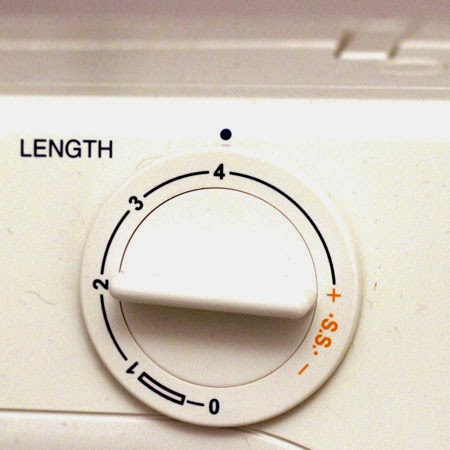
What is basting and why is it used

What is basting

 Uses are:
1. Temporarily hold the fabrics together before running the actual stitch. Its quick since it takes less time due to stitch length. I've used this for collars for a dress made for my daughter.
2. Temporarily hold the fabric to the zipper.  I've had not much luck with zips. Now that I've a new foot, I'll give it another so. You can see the post here - zipper foot not working
3Gathering You can see how basting rows of stitching helps in perfect gathers. - the gathering stitches are also called basting stitches.
4. Easing at the sleeves. Similar method of gathering is used to create ease at the top of the sleeves.

Thanks for reading.
Have a good weekend.

If you enjoyed reading this you can either like my facebook page to get all updates and more or you can opt to receive posts via email. Don't forget to activate your subscription though!

Saturday, 18 January 2014

What is seam allowance

Seam allowance - What is it and when to use smaller or larger seam allowances:


Seam allowance is the distance from the edge of the fabric to the stitching line. I generally use
smaller seam allowances  for:
- curved areas because it is easier to manage. My learning from difficulty  in sewing sleeves got me have smaller seam allowances
larger seam allowances for:
- straight finishes and especially when gathering is required because of the number of stitches needed within seam allowance to gather fabric.

How to sew for a given seam allowance:


Seam allowance plate guide
I'm here using a 1.5 cm seam allowance.  You can see on the plate that seam allowances are marked to the right and left of the sewing foot.


 seam allowance marking on sewing plate
 You'll need to position your fabric such that the fabric cut corner (circled in red) meets the seam allowance line (circled in blue) at the required seam allowance.


How to sew for a particular seam allowance
 I've here positioned it for 1.5 cm.

What is seam allowance and how much to use
Here it is - 1.5 cm seam allowance.


My machine doesn't have the needle in the center position so the seam allowance from the needle position to the guide on the machine is slightly larger than what the guide shows.
So I position my fabric slightly before the guide value I keep consistent seam allowance.

-Preethi.

If you enjoyed reading this you can either like my facebook page to get all updates and more or you can opt to receive posts via email. Don't forget to activate your subscription though!

Saturday, 11 January 2014

What is grain, selvage, warp, weft


When I started to sew 4 months back I was struggling to find what is
- From selvage to selvage?
- Cut on grain?
- Cut on bias?

What is grain, selvage, warp, weft
What is grain, bias, selvage, warp, weft
Online tutorials mentioned these words and I couldn't understand. I tried looking but didn't understand what it meant and so I cut the fabric the way it suited me to lay out. It was alright because I was sewing clothes for my little one which was forgiving but was difficult to sew in many places. It would have been disastrous if I were sewing for myself or sewing any fitted clothes.
Now that I understand, I thought why not share my understanding.
I've made this little diagram. I've compared everything to warp and weft on handloom (woven) because that is what I understand.
This is self explanatory in itself.  This does not apply for knit fabric though.

Warp (Length wise grain) :It is long strands of threads that run lengthwise on the loom. In the below you can see the red threads that is tightly tied. Since they are tightly tied, they do not have any stretch (give) and are highly stable to handle.
Handloom photos from Paramakudi explaining warp and weft

Generally fabric cut on lengthwise grain is perpendicular floor.

Weft (Crosswise grain): They are perpendicular to the lengthwise grain. Since the thread goes over and below the lengthwise grain they have some stretch.
Fabric cut on crosswise grain is parallel to floor.

what is grain
Example - Trousers - Cut lengthwise on grain, they stretch horizontally as the crosswise grain is horizontal. So, when you sit they stretch comfortably.  If they were cut on cross grain with horizontal as lengthwise grain it would be very unconformable with no stretch in it.
Here you can see clearly the warp and weft with weft going over and under warp. If you view your fabric towards light you can see the warp and weft clearly.


Selvage: The weft thread goes over and under the warp thread and at the edges it does the same. Hence the edges don't fray.

what is selvage
Picture here shows selvage. The white printed fabric running lengthwise on both ends of fabric (folded here and shown on right)
Do not cut your fabric selvage. The selvages helps to determine the way a fabric needs to be cut.


Bias: This is not actually a grain. Fabric cut at angles to selvage is called bias. Any fabric cut at angles will have stretch and more stretch than crosswise grain. True bias is cut at 45 degrees to selvage and has most stretch. Also this fabric is difficult to handle since it is not stable. A neckline or armhole has certain areas that are cut on bias. They very easily lose shape. It is therefore always advisable to stay stitch the neckline or armhole or any bias cuts immediately after it is cut.

I leave with you some of my pictures. I'm quite proud of them if I can say so myself. :). They are all taken at Paramakudi - my husband's home town.
handloom photos from Paramakudi explaining warp weft

handloom photos from Paramakudi explaining warp weft grain selvage

handloom photos from Paramakudi explaining warp weft

handloom photos from Paramakudi explaining warp weft grain selvage

Thanks.
I hope this was helpful?
Preethi

If you enjoyed reading this you can either like my facebook page to get all updates and more or you can opt to receive posts via email. Don't forget to activate your subscription though!

Related Posts Plugin for WordPress, Blogger...